

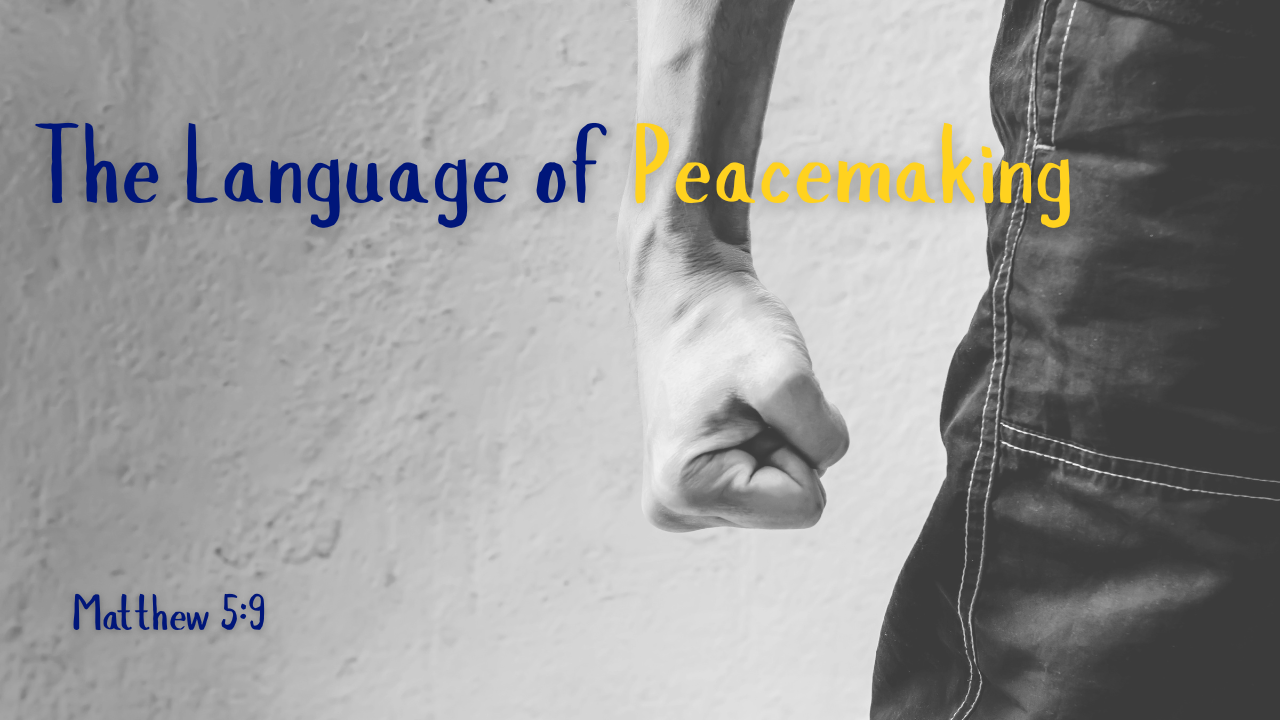

“Blessed are the peacemakers, for they will be called children of God.”
Matthew 5:9 (NET)
The more I study the Beatitudes, the more I’m convinced they are not merely eight (or nine, depending on how you count) distinct Kingdom qualities that constitute human flourishing. They are interrelated and, indeed, draw on one another to form a composite portrait of the ideal disciple of Christ. Discipleship begins with being poor in spirit, desperately aware of one’s impoverishment and utterly dependent on God. From there, it builds. The one who is poor in spirit knows how to mourn. Those who mourn are meek enough to live with open palms of surrender to God. The meek hunger and thirst for righteousness. And so forth. By the time we reach the peacemaker, the portrait becomes clear, and this beautifully earthy image appears on the canvas. The point is clear. The Kingdom’s citizens display virtues, ideals, convictions, or dreams that counter this world’s delusions of grandeur. They appear gloriously unspectacular.
The Beatitudes are the prelude to the rest of the Sermon on the Mount. It’s as if Jesus is saying that no one can understand, let alone live, his law of love until they embody the ethics of the Beatitudes. He is about to illustrate a whole new world, a new creation, one in which we need to be born again to comprehend. So, he presents the Beatitudes before the instructions. Skip the Beatitudes, and the rest of Matthew 5-7 make no sense at all. E. Stanley Jones says this about the Sermon on the Mount:
There is a “beyondness” in the Sermon on the Mount that startles and appalls the legalistic mind. It sees no limit to duty – the first mile does not suffice, he will go two; the coat is not enough, he will give the cloak also; to love friends is not enough, he will love enemies as well. Come to that with the legalistic mind and it is impossible and absurd; come to it with the mind of the lover and nothing else is possible. The lover’s attitude is not one of duty, but one of privilege. Here is the key to the Sermon on the Mount. We mistake it entirely if we look on it as the chart of the Christian’s duty; rather, it is the charter of the Christian’s liberty – his liberty to go beyond, to do the thing that love impels and not merely the thing that duty compels. The fact is that this is not a law at all, but a lyre, which we strike with the fingers of love in glad devotion. This glad, joyful piety is the expression of a love from within and not the compression of a dull law from without.
Put the Man who spoke these words into the background and look only at the sayings and they become as lofty as Himalayan peaks – and as impossible. But put the warm touch of his reinvigorating fellowship into it, and anything – everything – becomes possible.[1]
The Beatitudes are death to our old selves. They are a mortal threat to our pride, self-sufficiency, and the life we know in this world. But when we encounter them in Jesus, firstborn from the dead (Col. 1:18), they become the doorway to an unimaginably rich, sweet, and even abundant life.
So why this buildup to discuss the language of peacemaking? Because peacemaking requires the dawn of a new creation and the heart of a lover. “Peacekeeping” or “peace-faking” (for indeed, it can’t really be called “peacemaking”) in the spirit and wisdom of this age is a fool’s errand. It does not hold out the hope of reconciliation dreamed of in Scripture. But peacemaking, as a new creation ethic, requires being born of a new Father and embracing a new family name. Peacemakers are children of God. They are the ones who live into God’s “dream society on earth,” as theologian Scot McKnight describes the Kingdom of God.[2] The Kingdom of God is a reconciled community that lives into God’s dream of shalom, where “humans live out their connectedness” with God and others, and that connectedness is manifested in wholeness, justice, reconciliation, and repair; the world made right by the good reign of King Jesus.[3]
Peacemaking is so central to the gospel that it is no wonder Jesus carefully prepares us for it in his Beatitudes. Peacemaking is the life of Jesus lived in us. That is why it requires a whole new creation to be born in us. Here is how the apostle Paul describes it:
For God was pleased to have all his
fullness dwell in the Son
and through him to reconcile all things
to himself by making peace through the
blood of his cross – through him, whether
things on earth or things in heaven.And you were at one time strangers and enemies in your minds as expressed through your evil deeds, but now he has reconciled you by his physical body through death to present you holy, without blemish, and blameless before him – if indeed you remain in the faith, established and firm, without shifting from the hope of the gospel that you heard. This gospel has also been preached in all creation under heaven, and I, Paul, have become its servant. (Col. 1:19-23)
This means we most resemble Jesus, reflecting his divine image as sons of the Father, when we live out the kingdom-calling to peacemaking. Peacemaking reverses the curses of Genesis 3 and Deuteronomy 28. It is the manifestation of a whole new world coming down from heaven and making its home in this world, with God’s will being done on earth as it is in heaven (Matt. 6:10). And it’s happening through the lives of Jesus’ disciples, in whom his Spirit lives.
If this is true and we dare to dream so boldly about God’s dream society on earth, our leadership should reflect a primary ethic of reconciliation and peacemaking. But too often, I have experienced (and been an agent of) disorder and relational fracture in Christian leadership. I have seen the ways and wisdom of this world creeping into the worldview and perspectives of organizational leadership. It’s almost as if we think that conflict, reconciliation, and repair are secondary considerations in leadership, bumps we must get over to get on with the “real” work of leadership. We have a very myopic vision of what constitutes conflict and what the call of Kingdom peacemaking would have us do.
One of the gravest missteps we make in leadership is reducing conflict to a mere matter of who’s right and who’s wrong. When we do, we do unnecessary violence to the other. Perhaps we resort not to physical violence, but we cut down to size the perspectives, interests, needs, and ideas of those with whom we are in conflict. Suddenly, they become an obstacle to be overcome, a problem to be solved, or an enemy to be conquered. They are summarily denied the irreducible image of the divine in which they are created and redeemed. They are dehumanized. They become the “other” rather than a beloved member of the team. It is a violent and gross injustice in the courts of the Kingdom.
The late Dr. Marshall B. Rosenberg, author of Nonviolent Communication: A Language of Life, articulates this dehumanizing reality of violent communication well:
The Sufi poet Rumi once wrote, ‘Out beyond the ideas of wrongdoing and rightdoing, there is a field. I’ll meet you there.’ Life-alienating communication, however, traps us in a world of ideas about rightness and wrongness – a world of judgments. It is a language rich with words that classify and dichotomize people and their actions. When we speak this language, we judge others and their behavior while preoccupying ourselves with who’s good, bad, normal, abnormal, responsible, irresponsible, smart, ignorant, etc.[4]
No conflict is ever as simple as who’s right and who’s wrong. In most (dare I say all) conflicts, there are logs in our own eyes. Any form of conflict management that attacks, gaslights, accuses, or blames the other without first clearing the logs from our own eyes amounts to a miscarriage of justice, an unethical mockery of the law of love, and a violation of the King, who is the only judge worthy to decide between right and wrong. This is exactly why the Beatitudes of being poor in spirit, mourning, being meek, hungering and thirsting for righteousness, and being merciful and pure in heart necessarily precede peacemaking. Peacemaking is built up on the foundation of these earlier beatitudes.
Kingdom peacemaking embraces the full weight of the other’s existence: all their humanity, including their gifts, perspectives, interests, needs, dreams, wounds, personalities, neurological diversity, ethnicity, gender, cultures, and backgrounds. It refuses to diminish any of these in the pursuit of “peace.” It does not condescend or tell others how they ought to think or feel. It listens with curiosity, asks questions with appreciation, and lets its gentleness be evident to all (Phil. 4:6-7). Its heart beats for unity and peace, and it is not at rest until all is done to accomplish that. It hungers and thirsts for righteousness, not for being right over and against others. And it knows the difference between the two. It demonstrates radical mercy by refusing to let ungracious, diminishing narratives about others gain traction in decisions that affect their place at the table.
Peacemaking is central to our identity as children of God and as Christian leaders. The following Code of Ethics outlines the attitudes and practices that enable leaders to participate in God’s dream of shalom, where we can live out our connectedness to God and others in wholeness, justice, and reconciliation. It is a commitment to lead from the heart of the Beatitudes, so that our leadership becomes a living witness to the peace of Christ.
- I will lead from poverty of spirit, not self‑sufficiency: I will begin every leadership task with humility, acknowledging my dependence on God and my limitations. This posture keeps me grounded, teachable, and safe for others.
- I will practice self‑examination before addressing conflict: I will refuse to engage conflict without first searching my own motives, biases, and contributions. This protects me from self‑righteousness and prepares me to lead with integrity.
- I will refuse to dehumanize anyone: I will not reduce people to obstacles, problems, or enemies. I will honor the irreducible image of God in every person, especially in disagreement.
- I will listen with curiosity, not judgment: I will cultivate a listening posture that seeks to understand before being understood. This practice creates space for truth, healing, and shared discernment.
- I will let my gentleness be evident to all: I will embody a non‑anxious, non‑reactive presence in tense moments. Gentleness is not weakness; it is the strength of a heart anchored in Christ.
- I will hunger for righteousness, not for “being right”: I will prioritize relational wholeness over winning arguments. This ethic keeps the community’s flourishing at the center.
- I will practice radical mercy in all leadership decisions: I will refuse to allow ungracious narratives, assumptions, or suspicions to shape how I treat others. Mercy will be my default posture.
- I will reject violence in all its forms, including verbal, emotional, and organizational: I will not participate in communication or systems that diminish, shame, or silence others. I will cultivate a culture of safety and dignity instead.
- I will pursue reconciliation as a primary leadership task, not a secondary one: I will treat conflict, repair, and relational restoration as core to my calling. Kingdom leadership makes reconciliation central.
- I will lead as a child of God, participating in God’s dream of shalom: I will embrace peacemaking as my identity and vocation. My leadership will be a sign of the new creation breaking into the present.
[1] E. Stanley Jones, “Master Teacher,” in Following the Call: Living the Sermon on the Mount Together, ed. Charles E. Moore (Walden, NY: Plough Publishing House, 2021), 5-6.
[2] Scot McKnight, One.Life: Jesus Calls, We Follow (Grand Rapids: Zondervan, 2010), 31.
[3] Ibid. p. 33.
[4] Marshall B. Rosenberg, Nonviolent Communication: A Language of Life 3rd Edition (Encinitis: PuddleDancer Press, 2015), pp. 15-16.
